
The IONIX alternative for actionable exposure management
External exposure mapping is only step one. Intruder helps you find what’s exposed, understand what’s exploitable, and stay on top of change across your perimeter, apps, APIs, and cloud accounts.
Unified, always-on exposure management
IONIX helps you monitor external exposure across a wide ecosystem. Intruder helps you close risk faster in the environment you run, with continuous discovery, cloud posture checks, and authenticated app and API testing. You also get clear priorities and automation to keep remediation and retesting moving.

Prioritize real risk, not just exposure
Intruder uses exploit likelihood signals to separate general exposure findings from urgent risk, so your CTEM program stays focused on the issues most likely to be attacked first.

Go deeper than discovery
Intruder does not just map the perimeter. It can scan authenticated web apps and APIs to uncover common exploitable issues behind login pages, alongside broad infrastructure checks across your attack surface.

React to threats faster
When high-impact vulnerabilities emerge, speed determines exposure. Intruder proactively scans for new vulnerabilities as soon as new checks are created, helping you understand your exposure between scheduled scans.
Trusted by 3,000+ companies worldwide








Unparalleled visibility into your attack surface
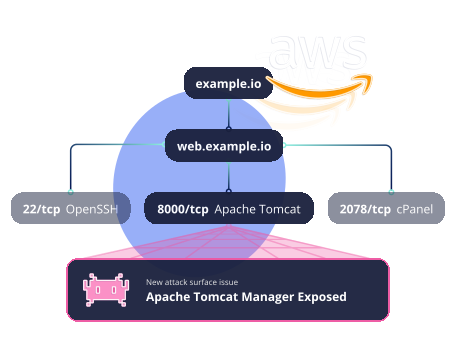
IONIX relies on outside-in scanning. Intruder goes further. By combining external discovery with cloud integrations and passive DNS, Intruder can uncover unlisted assets like forgotten subdomains, orphaned services, and newly exposed endpoints that are easy to miss with periodic reviews.

Secure your cloud from the inside out
An external view is only half the picture. Intruder integrates directly with your cloud accounts to audit the configuration itself, not just the perimeter. It pinpoints the settings driving exposure, such as insecure permissions or risky network access controls, so teams can fix the root cause rather than chasing symptoms.
Don’t just find assets, secure them
Static asset lists are obsolete the moment they are made. Intruder continuously monitors your environment, identifying new IPs and services as they appear. Crucially, it acts on them. When a change is detected, it automatically triggers a vulnerability scan, keeping cloud sprawl under control without manual intervention.

Automate your remediation workflows
Intruder bridges the gap between security and development with clear, actionable remediation advice and seamless integrations with Slack, Jira, and Azure DevOps.
GregAI, Intruder’s AI security analyst, helps triage findings, draft remediation notes, and explain root causes to accelerate fixes and close the loop between discovery and action.
Generate audit-ready reports, instantly
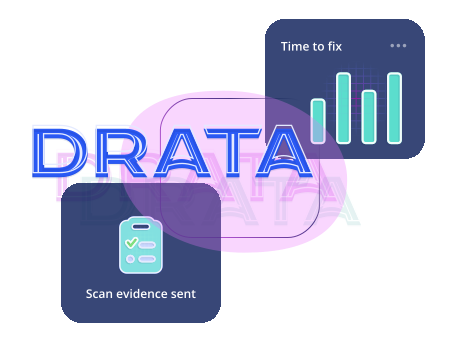
Streamline your entire audit process and eliminate manual evidence gathering. Intruder provides instant, audit-ready reports for SOC 2 or ISO 27001. For ultimate efficiency, connect directly with your compliance platform and automatically send vulnerability evidence to services like Drata and Vanta, saving your team countless hours.
See what real users think of Intruder



Ben Camilleri
CTO at Westhaven Association
Intruder checks your systems for 170,000+ infrastructure weaknesses (such as remote code execution flaws), 75+ web-layer security issues (such as SQL injection and cross-site scripting), and other misconfigurations (such as weak encryption and services that are unnecessarily exposed). Learn more about what checks we run.
Intruder's emerging threat scans check your systems for newly discovered vulnerabilities automatically, as soon as a check is available. You'll know whether you're exposed without lifting a finger, with no need to research the latest threats or run scans manually. Learn more.
Intruder is powered by industry-leading scanners, including Tenable, Nuclei, OpenVas, and ZAP. Learn more.