.svg)
.png)



Key Points
AI pentesting can mean different things from vendor to vendor, and one of the biggest differences is how much a tool does on its own. We've grouped the top AI pentesting tools on the market into three levels of autonomy:
- Fully autonomous: Runs end-to-end with no human step required, from discovery through to chaining findings into more serious exploits.
- Autonomous with a human checkpoint: Runs autonomously, but a human has to approve a specific step, like escalating a finding into further exploitation.
- Deterministic core with an AI layer: Not a freely-reasoning agent, but a fixed, pre-validated engine with AI added for adaptation or analysis.
.png)
We've broken down each tool’s strengths, limitations, and what type of team each one best suits.
Top AI pentesting tools compared
1. Intruder
Autonomy: Fully autonomous
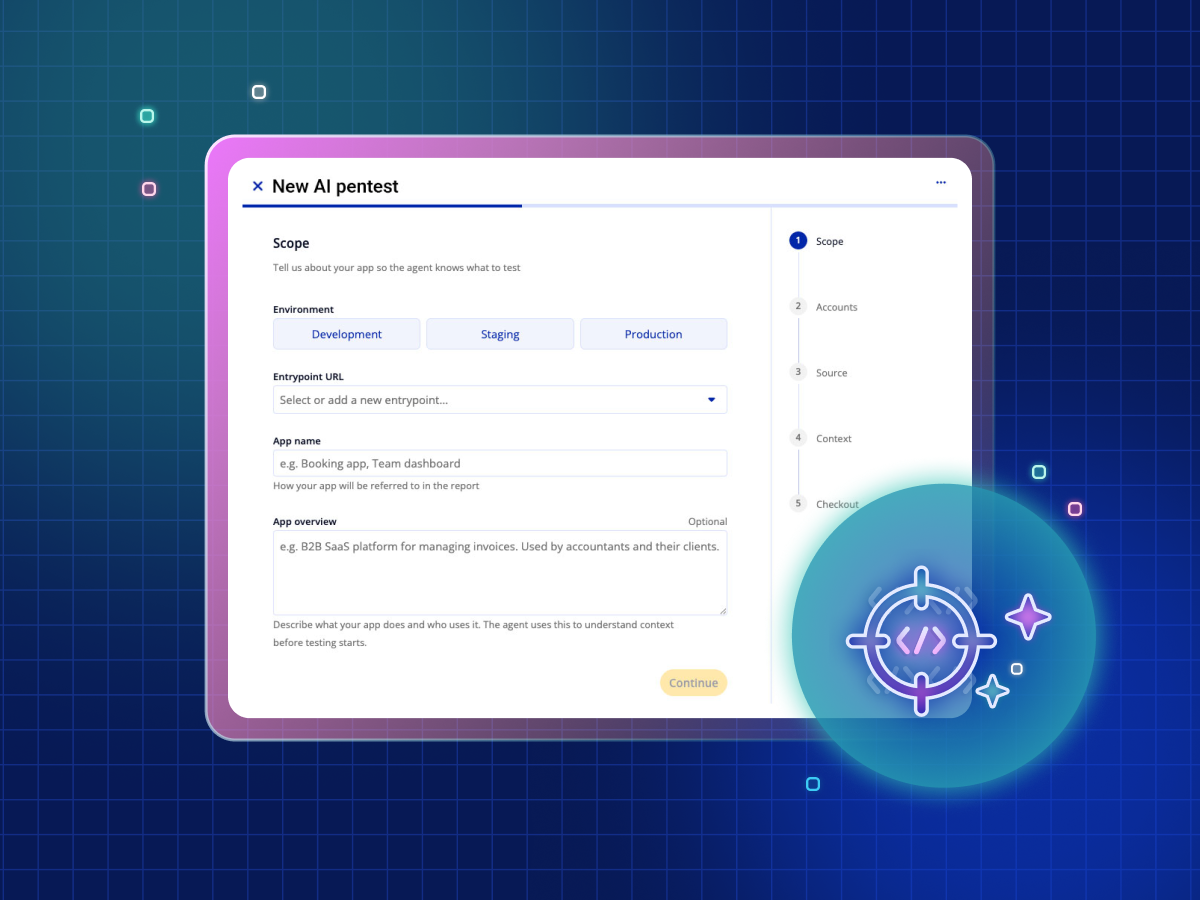
Intruder's AI pentesting runs fully autonomous agents against web applications on-demand, taking a white-box approach: reading your source code directly rather than only probing from the outside. That gives them full knowledge of how endpoints and APIs are actually built, mapping them automatically, with no schema upload required. They use this information to reason through the app the way a human tester would. The agents detect issues like IDORs and business logic flaws, and can chain smaller issues into complex exploits. Every finding is validated against the application before it's reported.
Coverage
- Web applications and their APIs
Strengths
- White-box testing uncovers significantly more vulnerabilities than testing blind, Intruder connects directly to your GitHub or GitLab repository so every test runs with full knowledge of your actual source code.
- Reports are detailed and actionable, citing the actual vulnerable code with exact file and line numbers, and explaining why the flaw exists architecturally. See a sample report.
- Tests the way an accredited, experienced human pentester would, built and trained by Intruder’s CREST and OSCP-certified pentesters and security research team, credited with real vulnerabilities like CVE-2025-0589 in Octopus Deploy.
Limitations
- Scope is web applications and their APIs, not wider infrastructure, cloud, or identity.
Best for
Ideal for engineering, IT, and security teams, whether they want AI pentesting on its own or as part of a consolidated exposure management platform spanning attack surface management, vulnerability management, and cloud security posture management.
Pricing
Intruder’s AI pentests start from $4,000 per test, or $3,500 for existing Intruder customers.
2. XBOW
Autonomy: Fully autonomous
XBOW is an autonomous offensive security platform for web applications. Given a target and any available context, such as documentation, credentials, API specs, or architecture notes, a coordination layer decides what to test and in what order. The agents then map the attack surface, chain vulnerabilities, and exploit them in parallel. Before anything is reported, each finding has to be confirmed with a working, reproducible exploit, which filters out the false positives that come from model hallucinations.

Coverage
- Web applications and their APIs
Strengths
- XBOW isn't tied to a single AI model. It routes each task to whichever model handles it best and picks up new models as they're released, so testing keeps improving as the models do.
- Connect the API to your systems and launch pentests automatically, whether as a security gate before a release ships or to cover a large estate of apps on your schedule.
Limitations
- Scope is web applications, so it does not cover internal network, cloud infrastructure, or identity and Active Directory testing.
- It goes deeper the more context you give it, so a test with just a target URL finds less than one supported with credentials, docs, and API specs.
Best for
Best for fast-moving startups that can't afford to wait weeks for pentest results before a deal or release, scaling up to large enterprises managing pentesting across dozens of applications via the API.
Pricing
Standalone pentests start at $4,000. Broader or continuous coverage across a portfolio is usage-based and quote-only.
3. Strix
Autonomy: Fully autonomous
Strix is an open-source, agentic security platform built on a graph model that arranges specialized agents into workflows, recon, exploitation, and post-exploitation, which work in parallel and adjust their tasks as others discover new information. It runs your code dynamically inside an isolated Docker sandbox, probing endpoints the way a real attacker would, and validates every finding with a working proof-of-concept exploit before it's reported. It's available as a command-line interface (CLI) or through its own hosted platform.

Coverage
- Web applications and their APIs
- Internal apps and infrastructure
Strengths
- You choose which AI model powers the agents, and can switch providers without needing a new tool.
- Auto-fix generates AI-written security patches delivered as ready-to-merge pull requests for confirmed issues, not just a written description of the fix.
- Integrates with pipelines like GitHub Actions, so testing runs automatically before code reaches production.
Limitations
- The software is free, but the agents consume LLM tokens billed directly by your provider, and Strix recommends top-tier models for best results, so costs scale with usage and can be unpredictable.
- Running the self-hosted version requires Docker and Python, which adds setup for teams wanting the CLI rather than the hosted platform.
Best for
Developer teams that want a free, self-hosted, open-source tool they run and control themselves.
Pricing
Free open-source CLI (bring your own LLM tokens). The hosted platform's Pro plan is $29/seat/month for continuous use. A standalone pentest engagement starts from $1,000, with custom Enterprise pricing for deeper coverage and multiple apps.
4. Escape
Autonomy: Fully autonomous
Escape is an AI pentesting platform built specifically around business logic. Its multi-agent engine, Cascade, learns an application's user roles, state, and data model before it starts testing. It proves exploitability with a full request chain and attack-path validation, and every confirmed finding is converted into a regression test that reruns automatically on every future build through Escape's DAST engine.

Coverage
- Web applications and their APIs
Strengths
- Once a finding is proven, it's automatically turned into a check that reruns on every future release, so you don't have to rediscover the same issue twice.
- Generates remediation code tailored to your exact source code.
- Integrates directly into your CI/CD pipeline, so testing runs as part of your existing release process rather than as a separate step.
Limitations
- Coverage centres on web apps and APIs, not infrastructure, cloud, or identity.
Best for
Mid-size to large engineering-led organizations shipping web apps and APIs frequently.
Pricing
Quote needed.
5. Amazon - AWS Security Agent
Autonomy: Fully autonomous
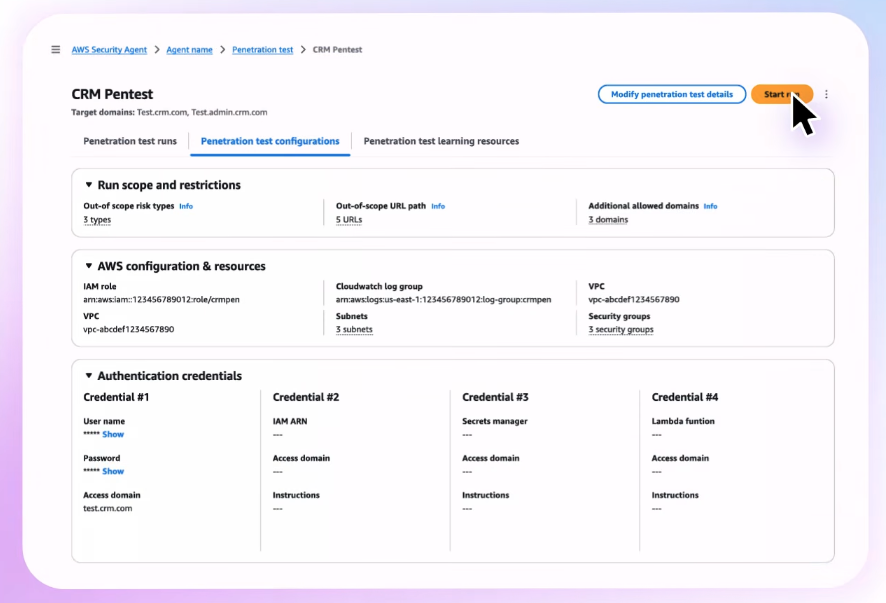
AWS Security Agent (part of AWS Continuum) is an agent that secures applications across the development lifecycle. It runs on-demand penetration tests tailored to your application, learning from your source code and documentation to find vulnerabilities, then validating each finding through exploitation before reporting it with a reproducible attack path and a ready-to-implement fix.
Coverage
- Web applications and their API’s
Strengths
- You can define your organization's security and compliance requirements, including managed packs for PCI DSS, NIST CSF and AWS WAF, and have testing validated against them automatically, with findings mapped back to your compliance posture.
Limitations
- Scope is web applications and their APIs, not wider infrastructure, cloud, or identity.
Best for
Engineering teams building on AWS that want security embedded across the whole lifecycle, from design docs and pull requests through to on-demand pentesting.
Pricing
Pay-as-you-go at $50 per task-hour. Task-hours measure the agent's total work across all the tasks it runs in parallel, so they add up faster than the test's actual run time. AWS's own examples put a typical test around $170, and a larger enterprise test around $1,200 to $1,560.
6. Aikido
Autonomy: Autonomous with a human checkpoint
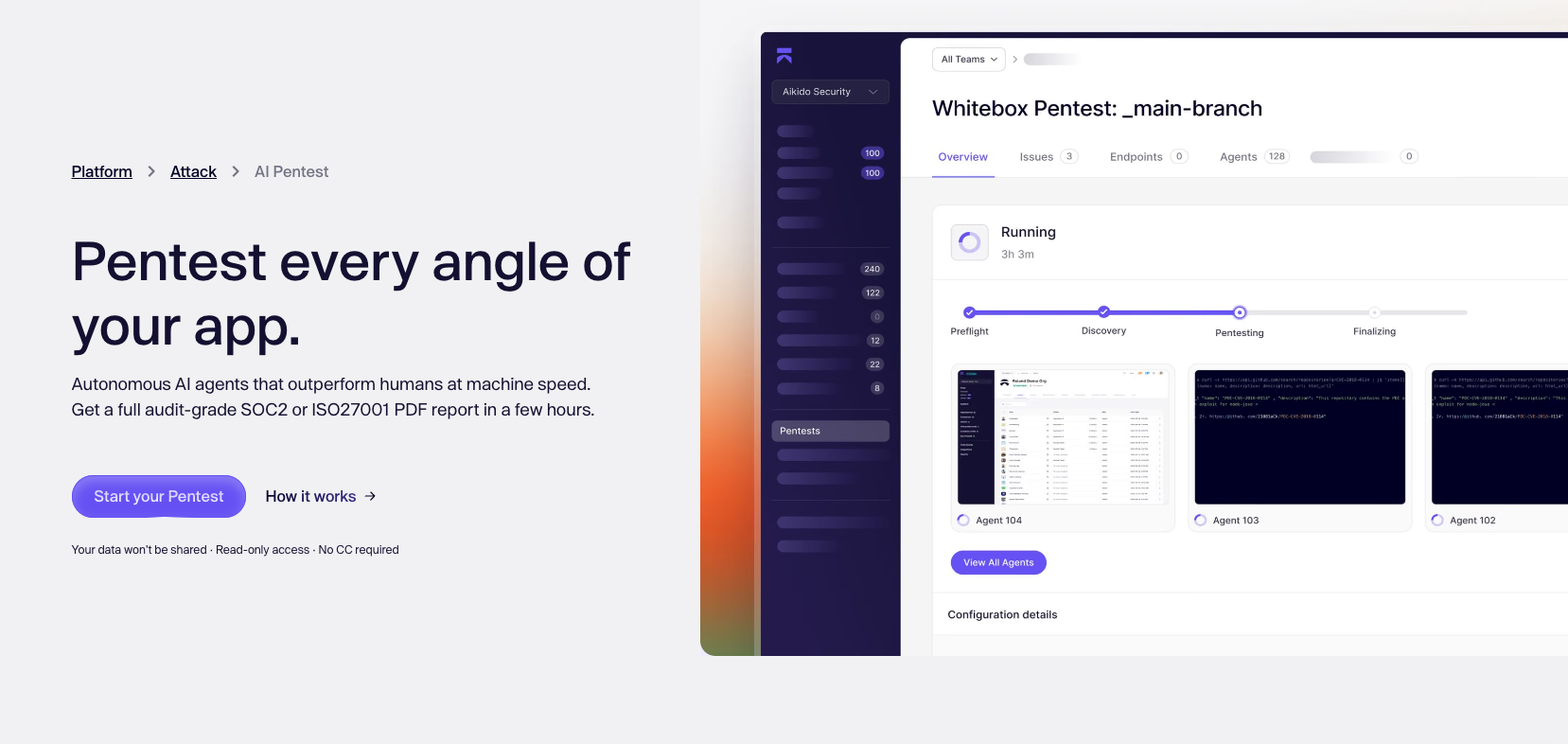
Aikido runs AI-driven pentests against web apps. It first maps the attack surface, either white-box from your code and API specs or black-box against the live app, then dispatches a set of agents, each focused on a specific attack vector, working in parallel across the target. The run is fully autonomous up to a confirmed finding: Aikido stops there by default, and pushing a finding into deeper, chained exploitation is a human-triggered option rather than something it does unprompted.
Coverage
- Web applications and their APIs
Strengths
- Retest findings for up to 90 days after the initial pentest to confirm a fix worked, without launching a new pentest.
- AutoFix generates high-confidence pull requests for confirmed issues, tied to Aikido's understanding of your code.
Limitations
- Scope is web applications and their APIs, not wider infrastructure, cloud, or identity.
- Source code access is optional but materially improves results, so the deepest coverage assumes you connect repositories.
- Aikido stops at a confirmed finding and needs a human to opt into deeper exploitation.
Best for
Engineering and security teams that want to consolidate multiple AppSec tools (SAST, SCA, cloud, pentesting) into a single platform.
Pricing
Aikido offers two pentest pricing models: a flat Standard test starting from $4,000, or a Rightsized test that's automatically scoped to your application's complexity, ranging from $500 to $30,000+. Continuous testing is custom priced.
7. Horizon3.ai (NodeZero)
Autonomy: Deterministic core with an AI layer
NodeZero executes autonomously, navigating your network without scripts and chaining weaknesses based on what it discovers to demonstrate impact far beyond CVEs. It never uses GenAI to create or run the exploits themselves, though: those are deterministic and pre-validated, with the AI scoped to planning and analysis, like prioritizing findings and analyzing web application logic for flaws. Internal tests run from a Docker host or virtual appliance deployed inside your network; external tests run entirely from Horizon3.ai's cloud. Every finding ships with a proof of exploit.

Coverage
- Internal networks
- External networks
- Cloud (AWS, Azure / Entra ID, Kubernetes)
- Active Directory and identity
- Web apps
Strengths
- One-click retest verifies that fixes have been successful without starting a new test.
- One platform covers internal and external network pentesting together, and scales to test multiple network segments at the same time.
- FedRAMP High authorized for compliance-sensitive federal and public-sector deployments.
Limitations
- Internal testing requires deploying a Docker host or virtual appliance inside the environment, so there is a setup step and an on-network footprint.
- Web app pentesting is still in Early Access, so it's less mature than the platform's established network, cloud, and identity testing.
Best for
Mid-market to enterprise security teams, MSPs, and public-sector or federal organizations that want continuous, self-service pentesting across their full internal, external, and cloud estate.
Pricing
Quote needed.
8. Pentera
Autonomy: Deterministic core with an AI layer
Pentera is an Automated Security Validation platform built on a long-standing deterministic attack engine, one that runs the same controlled, repeatable techniques every time rather than reasoning freely. An AI layer now sits on top of that engine, adapting techniques and payloads in real time and reading application structure, inputs, and responses to emulate more realistic attacks. Nothing is reported unless the platform has actually proven it's exploitable. Every action stays controlled and repeatable by design, which is what lets Pentera run safely against production environments rather than requiring a staging instance.

Coverage
- Internal networks
- External networks
- Cloud (identity and hybrid)
- Active Directory and identity
- External web attack surface (perimeter and authentication points, not deep authenticated business logic)
Strengths
- Internal, external, cloud, and identity testing together, rather than needing separate tools for each.
- Pentera Resolve turns validated findings into remediation tasks that get assigned to someone and re-checked once applied, so nothing sits unowned or unconfirmed.
- Specific focus on PCI DSS compliance, with dedicated testing designed around cardholder data environments.
Limitations
- Deterministic core with an AI layer rather than a fully autonomous LLM agent, so on a strict "agentic AI" definition it sits closer to AI-augmented validation.
- Web coverage is external attack surface and authentication points, not deep authenticated business logic testing, teams needing that depth will want a dedicated web app pentesting tool alongside Pentera.
Best for
Security teams that need to continuously validate whether their live environment is exploitable, safely and repeatably.
Pricing
Quote needed.
AI pentesting tools compared
Frequently asked questions about AI pentesting tools
Do AI pentesting reports satisfy compliance requirements?
Most compliance frameworks, such as SOC 2, ISO 27001, and HIPAA, don't specify who or what has to run the test. They ask for evidence that testing happened, followed a defined methodology, was properly documented, and that anything critical was remediated. A report from any of these platforms that does all of that generally satisfies the requirement just as well as a human-led pentest would.
PCI DSS is more prescriptive. Under the current v4.0 standard, a penetration test still needs to demonstrate human-driven exploitation and proof of impact, not just automated findings, so it's worth checking directly with your auditor if that's the framework you're testing against.
Can AI pentesting tools replace manual pentesting?
For the vast majority of web app pentesting, yes, the reasoning and capability of current models are good enough to run without a human in the loop and they can hold more of a codebase in context than any human tester can. There are still edge cases where a human pentest is preferable, particularly safety systems, where the accountability and risk tolerance involved are on a different level.
You can read our deep dive on whether AI pentesting is as good as a human pentester.
Is AI pentesting safe to run?
AI pentesting is as safe to run as a human-led pentesting. Neither is risk-free: people can make mistakes and a non-deterministic AI system can behave unpredictably too. The same mitigations that are recommended for manual pentests apply here: avoid testing in production wherever possible, keep validated backups, and make sure disaster recovery works if something goes wrong.
We’ve got more info in our guide: Everything you need to know about AI web app pentesting
Does AI pentesting produce false positives?
AI pentesting tools produce significantly fewer false positives than vulnerability scanning or DAST, and often produce less than what a human pentester would produce. This is down to the validation process: rather than flagging anything that looks like a match, AI pentesting platforms test each finding to confirm it actually holds up before it's ever reported.
Does AI pentesting hallucinate?
In principle, AI pentesting can hallucinate like any AI system, an agent could confidently describe a vulnerability that isn't actually there. That's why validation is so important: a good AI pentesting solution won't report a finding until it's been proven by running the actual exploit against the system, which is what keeps hallucinated findings out of the final report.
How much does AI pentesting cost?
AI pentesting pricing has shifted from consultant day rates (typically $1,500–$2,500/day for a human-led test) to per-test or subscription pricing, usually landing somewhere between $4,000 and $8,000 depending on the platform and depth of testing. Because an AI pentest can cover in hours what would take a human tester days, most teams find they can run several tests a year for what a single manual engagement used to cost.
How AI pentesting helps lean teams keep pace
AI-assisted coding helps engineering teams ship more often, but the same technology is enabling attackers to find and exploit weaknesses faster. More code to test and less time to test it makes the gap between annual pentests riskier than it used to be. AI pentesting closes that gap. With Intruder, there's no procurement, no scoping calls, no waiting weeks for a slot. Scope a pentest and launch it whenever you need one. Run an AI pentest today or book a demo.

Vulnerabulletin


.png)