.svg)



Key Points
A new vulnerability hits the headlines, and the first question every security team asks is: are we affected?
Answering this has traditionally meant waiting for a vendor to publish a detection check, and then hoping that check actually confirms the weakness rather than just flagging a vulnerable version which may not be exploitable. That delay is a problem, because the gap between a vulnerability being disclosed and being exploited is closing fast. The ZeroDayClock now puts average time-to-exploit at under a single day in 2026, and projects just one hour by 2027. There's also far more to keep up with than there used to be, with vulnerability volumes nearly doubling in two years.
Closing that gap has historically been difficult. Our security engineers research new vulnerabilities and write checks for them, which is careful, accurate work, but manual effort can only produce so many, and the threats don't wait their turn.
So we built something to even the odds: AI vulnerability management. Available on our Enterprise plan, it automatically builds checks for newly disclosed vulnerabilities, so coverage arrives faster and discovers far more of your lurking weaknesses.
What can AI do for vulnerability management?
Checks you won't find elsewhere: because we're generating checks for new vulnerabilities as they emerge, you get detection for some weaknesses other scanners haven't built checks for yet, and in many cases never will.
Faster coverage for new threats: when a vulnerability is disclosed, the work to build a check for it starts right away, so you find out whether you're affected sooner. Our AI pipeline averages under an hour from NVD analysis to check completed and ready for QA.
Broader coverage for an expanding threat landscape: writing a check manually takes time, creating a bottleneck. The AI pipeline doesn't have that ceiling, so it covers far more of what's out there, not just the high-priority vulnerabilities we have capacity for.
Checks that confirm real exposure: these are active checks. They safely interact with your systems to prove a weakness is actually present, rather than inferring risk from a version number.
How does AI-enabled vulnerability management work?
The idea is straightforward. Give the system a single vulnerability, and it produces a finished, tested check. Along the way, it gathers what's known about the flaw, works out how it could be exploited, safely tests that in an isolated environment to confirm it's real, then packages the result into a check we can run.
What it doesn't do is ship anything on its own. The system checks its own work at each stage, but a person is always in the loop. Our security engineers review, test, and vet every check, and decide what gets deployed. Only checks that pass reach your account.
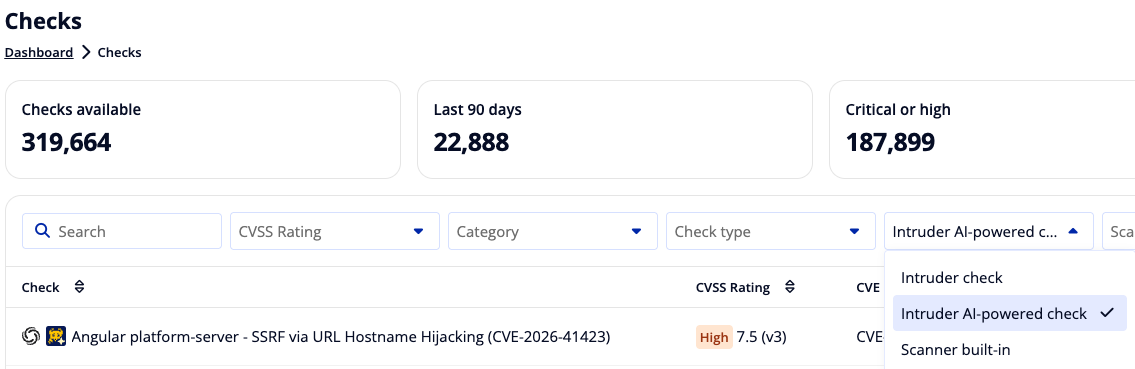
You can see exactly which checks were built this way by filtering your checks list to "Intruder AI-powered check."
Broader coverage, fewer blind spots
It's common to assume every vulnerability scanner checks for the same things, that breadth of coverage is a solved problem, and the only difference is the interface. It isn't. Scanners vary widely in what they actually detect, and as the volume of new vulnerabilities climbs, those differences are even more crucial. A gap in coverage isn't just a missed check. It's a blind spot that can leave you confident you're secure when you aren't.
That's where speed and volume change the picture. It means you get detections for newly disclosed vulnerabilities that other scanners haven't caught up to yet. In our first month, 90% of the checks we produced weren't yet available from other major vulnerability scanners. A month on, one publicly traded category leader with over 2,000 employees still hasn't published checks for many of the vulnerabilities we cover. Some of those gaps will close eventually. Others never will.
And it's already finding real exposures. Shortly after we deployed our earliest checks, our emerging threat scans (ETS) ran and caught five high-impact weaknesses across multiple Enterprise customers.
Reinforcing the foundations of exposure management with AI
AI is opening up real opportunities across security, and we tend to look at it in two ways: what it can do for existing capabilities, and what entirely new opportunities it makes possible.
The new things get most of the excitement, and rightly so. GregAI, our AI security analyst, and our AI pentesting agents are exciting, and a big part of where we're headed. But the fundamentals are easy to overlook in all that. Detection is still the foundation of exposure management, and with the volume of new vulnerabilities climbing, it has to keep up. That's what AI vulnerability management is built for.
Already on Enterprise? Log in to see the checks the AI has built for your targets. Interested in how Intruder is helping defenders keep up? Book a meeting with one of our wonderful humans.

Vulnerabulletin


.avif)

.avif)