
Intruder for

Measure cyber hygiene
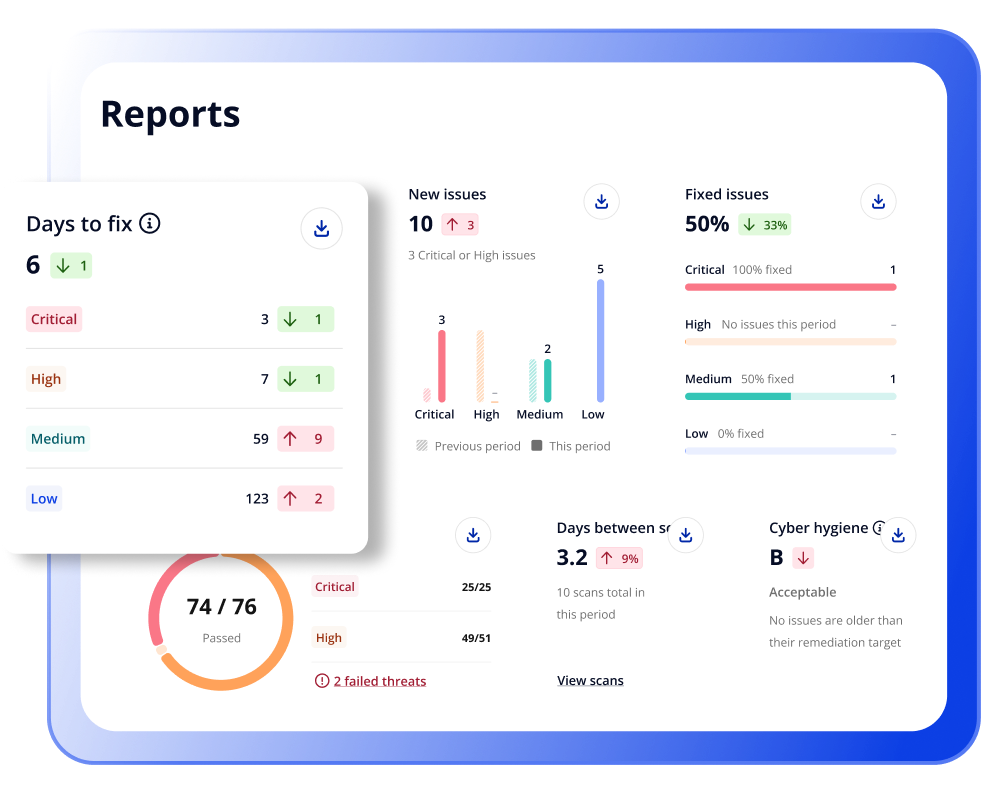
Monitor your security posture, understand how it’s changing over time and get insights for how to improve.
Join 3,000+ companies securing their attack surface with Intruder









One view of your security posture
Stop piecing together insights from different tools and spreadsheets. Intruder plugs into your entire digital estate to provide a single view of cyber hygiene.
.svg)
Show progress to stakeholders
Prove the work your doing is moving the needle. Easily show stakeholders how your number of open issues, time to fix, and cyber hygiene score are changing over time.
.svg)
Identify problems early
Spot negative trends and pain points early so you can take corrective action, or build the business case for additional resources.

Quantify your security posture
Real-time threat level
.svg)
Get an easy to understand, live view of your threat level based on the number of unresolved vulnerabilities and attack surface issues. Scoring is weighted so critical issues with known exploits carry more impact.
Cyber hygiene score
Define your cyber hygiene goals by specifying target remediation times by issue severity. Automatically track performance against these goals on your Intruder dashboard.
Compliance ready scan reports
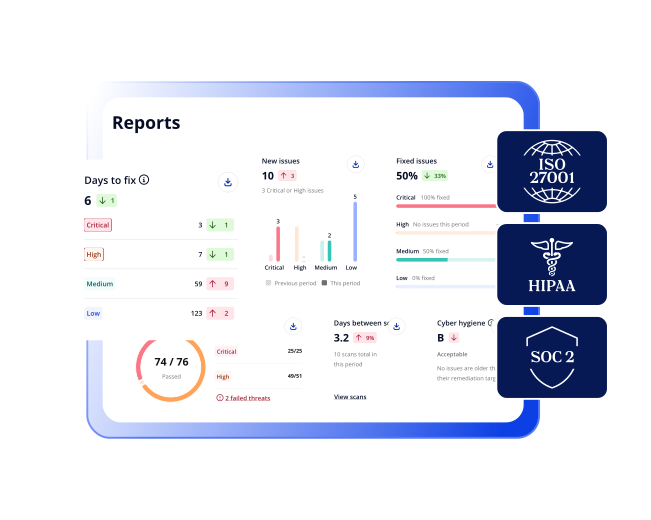
Detailed reports show all your scanner findings and can easily be shared with auditors, or automatically sent to GRC platforms including Vanta and Drata.

.svg)
Find what's exposed, fix what matters, and stay ahead of new threats

External Scanning
Infrastructure Security

Attack Surface Monitoring
Respond to changes

CSPM
Daily cloud config checks

Asset Discovery
Reveal unknown targets

DAST
Secure web apps

Risk Based Prioritization
No more alert fatigue

Cyber Hygiene Reporting
Demonstrate progress

Emerging Threat Detection
Check and act fast

Container Image Scanning
Automated image discovery

Secrets Detection
Prevent leaked credentials

Website Security
140k+ checks

API Security
Test your APIs

Compliance
SOC 2, ISO, HIPAA, DORA

Internal Scanning
Secure employee devices
Our customers love Intruder

.png)


.avif)
.svg)
.png)


One platform. Continuous security.
Yes, you can! Learn all about how to scan SPAs with Intruder here.
The first thing you need to do is add your website as a target by entering its IP address or url. You can then kick off your first scan in just a few clicks – it’s that simple!
Intruder’s website security scans check for web-layer security problems such as SQL injection and cross-site scripting, as well as other security misconfigurations. Read more about Intruder’s checks here.
Your internal systems can be just as enticing to hackers as your external network so it’s important to test your website for vulnerabilities there too.
When we talk about scanning the website internally, we’re actually talking about scanning the web server that the website is hosted on. Web servers are internet-facing, but any sensitive information connected to them (such as databases) will sit behind a firewall, to prevent them from being reached by unauthorized individuals.
If ‘stuff’ can’t be reached externally, then remote checks won’t work and so you’d need to run local checks. At Intruder, all local/internal checks are performed via an agent which you’d install on the server.
Internal vulnerability scanning also hunts through your website for missing patches and detects insecure versions of many thousands of software components and frameworks, including operating systems and network devices. Find out more about internal vulnerability scanning.
Intruder works with many platforms, including WordPress, Drupal, Joomla, Squarespace and more.
Choose our Essential or Cloud plan to externally scan your website. If you are looking at our internal vulnerability scanning capability, this is only available to our Pro and Enterprise customers. Visit our pricing page to learn more.
Buy any of our Essential or Pro plans that cover infrastructure licenses by default. Head to our pricing page for more information.