

TL;DR
- CVE-2026-118633 involves the sending of emails to a Sophos UTM to get root. No authentication needed, and the address doesn’t even have to exist.
- Any UTM with inbound email scanning on is at risk, even when the admin panel isn’t exposed.
- Defenders should patch now
- Our report sat ignored for 45 days, providing further evidence that bug bounty programs and vendors struggle to cope with increased volume of AI slop reports
CVE-2026-118633 definitely earns its 'Critical' rating. In Sophos UTM, when configured as an email gateway for malware scanning inbound emails, a remote attacker can gain access to the device - as root! – just by sending a malicious email to someone at the organization.

Directory traversal
When the device receives an email that needs scanning (configurable – but the norm would be to apply this to all external emails), it hands this off to the cssd daemon, which handles interfacing with the various anti-malware backends used on the device. cssd will take the Message-ID header, which is attacker-provided over SMTP, and parse this using the open-source library libgmime.
The value of this header is then used to construct a path where the contents of the email are written so they can be scanned - but due to a validation issue, this path can contain characters that break out of the intended directory, and so the attacker can write the file anywhere on the filesystem - a standard “path traversal” type vulnerability. The contents of the file come from the email body, so are also attacker-controlled.
The usual path to further exploitation would be to overwrite a configuration file to do something malicious, but there's a mitigating factor here: the file is opened with the O_EXCL flag, meaning that although an attacker can write a file anywhere, they can only create new files, not overwrite existing ones. Also, because this is a temporary file, it gets deleted as soon as the scan is complete - usually within a fraction of a second. We tried various techniques to prevent this but couldn't find a way to make the file stick around indefinitely.
Exploitation
A create-only, extremely short-lived file write doesn't sound very impactful. However, we found a way to turn this into code execution: the Cron daemon, which is the service used by the OS to schedule recurring tasks.
Cron on this device checks /etc/cron.d/ for new configuration files every 60 seconds. So, the attacker just has to store their malicious file there when this occurs. Guessing the precise timing is very unlikely, but by sending many emails and racing the Cron daemon, we've proven it is reliable to gain command execution.
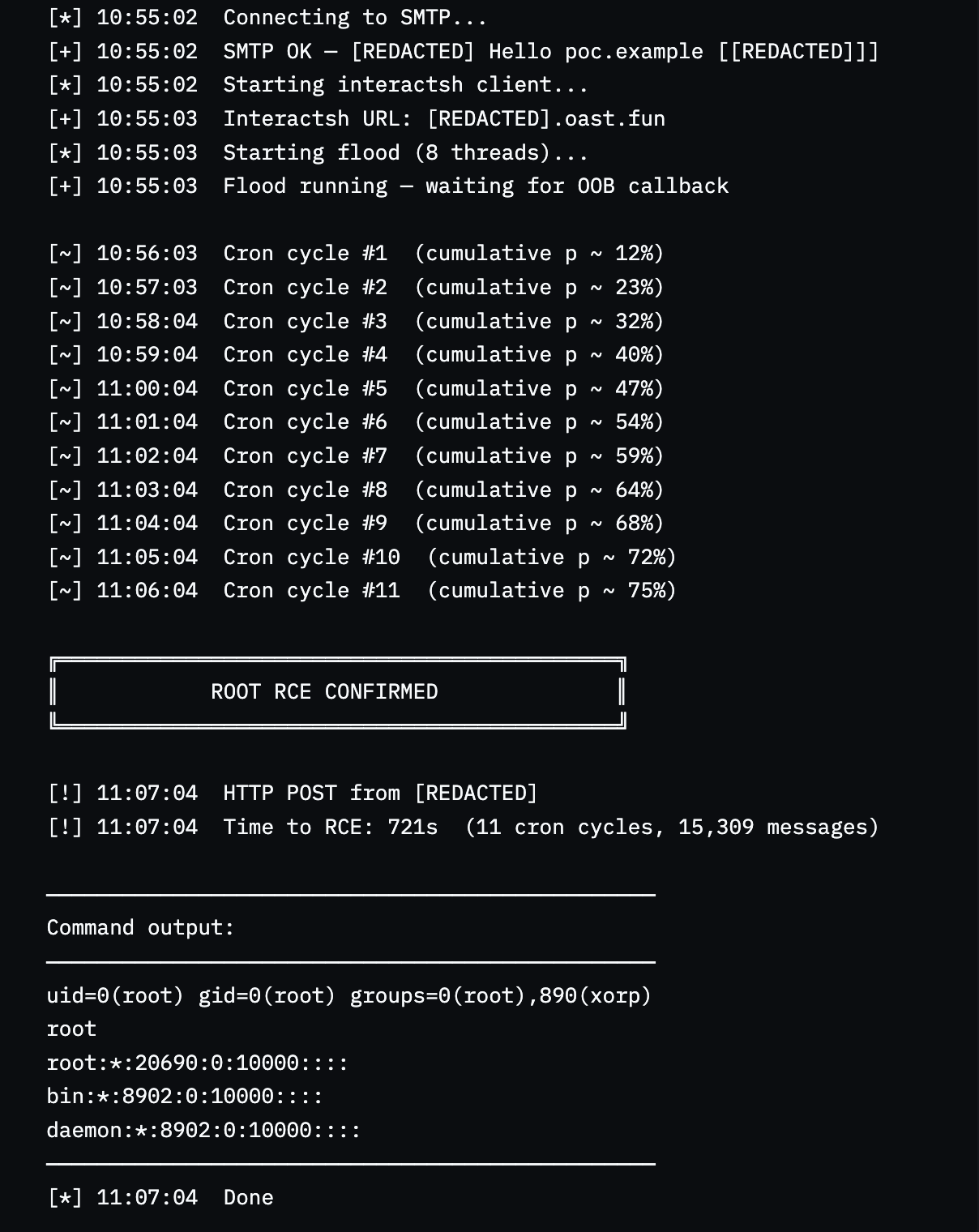
In our test environment, this took around 15,000 emails over 10 minutes to land a successful shell. Bear in mind, these are being sent over SMTP directly to the device (i.e. there's no need to transfer 15,000 emails across external MTAs or similar, which would be noisy and unpredictable).
There's also almost certainly optimization to be made here - we sent emails consistently for the whole period, whereas a fully “weaponized” exploit would likely send in bursts around the minute boundaries to keep the volume of emails down. Even with our proof-of-concept however, the shell lands reliably, and works even when a non-existent email address is the target. How closely do you monitor email spam sent to non-existent addresses?
This vulnerability has now been patched, but we have made the choice to not release the proof-of-concept script. There are a few tricks that make exploitation of the weakness very reliable, which we’ve also decided not to report on here.
Who is affected
The impacted product, Sophos UTM Gateway, is end-of-life as of June 30th, and new licenses are not being issued - customers are supposed to switch to the new SFOS-based products instead. Fair enough.
But, extended support is available until December 31, and many users are still running the vulnerable product today - we found a lot of them exposed via Shodan, which in this case doesn't even tell the full story, as this will only show instances with exposed administrative panels. The kicker here is that this vulnerability affects you even if you don't expose the panel, as it's in the email scanning feature – something that is less visible to port scan surveys, and intended to be exposed to the outside. Any vulnerability that can get you root from sending an email to a non-existent address should be taken seriously, even if the product is in extended support.
Remediation
If you are still running Sophos UTM (or likely also, a Sophos XG hardware device, although we can't confirm this), and you use the mail scanning feature, you are vulnerable. Patch as soon as possible (ideally two weeks ago!) - see the advisory here for details. You should also stop using the device as soon as possible, as Sophos has marked them end-of-life and support will eventually end even for existing contracts.
If you can't patch for whatever reason, you should disable inbound email scanning. This has its own risks but will prevent the vulnerability being exploited in the short term while you find an alternative.
Disclosure challenges
With such a critical vulnerability in hand, it’s important to report to the vendor and coordinate to get a patch out as soon as possible. And this is where we ran into hurdles.
First, as directed by the Sophos disclosure policy, we emailed them letting them know we had a vulnerability to report, so they could provide a PGP key and request full details. We unfortunately didn't receive any reply from them until our third time chasing (45 days after the first email), when we were just about ready to give up.
After our initial direct outreach failed, we also tried reporting via their bug bounty program, which is managed by Bugcrowd. This product technically falls outside the scope of their bug bounty rewards - but we aren't interested in a reward here, we just want to make them aware of the issue, so we reported it under 'Other products'.
After waiting 3 weeks for anyone to look at it, the submission was closed by the triage team, without ever being passed to Sophos. The rejection reason was:
In order to be a triaged issue a submission must demonstrate an impact that can have an effect on the customer, the application/website, or its users. Submissions should always answer the question, "as an attacker I could", with a suitable demonstration of such. [...] Please ensure the findings are properly verified and supported by a reproducible PoC demonstrating the actual security impact before submitting any reports.
This response was frustrating given the question 'as an attacker I could' was answered in the very first sentence of our submission:
Sophos UTM appliances contain a path traversal vulnerability in the mail gateway, which can be used to perform remote code execution by an unauthenticated attacker. This was tested and confirmed to work on 9.724-2.
And the “reproducible PoC” was the exploit script described earlier in this post – which we supplied, and had tested against our own environments to gain a shell several times. This was attached to the submission from day 1, and we also included the output of one of our runs showing the exploit in action, so the triage team could see the impact:
Thankfully, we eventually got through to the right team at Sophos via a direct route, and they explained that they are inundated with reports (much of which is AI slop), and that ours got lost in the noise. The disclosure experience has revealed learnings for both reporters and vendors and highlights the urgent need for policies to evolve to ensure serious issues are not being overlooked as the volume of AI generated vulnerability reports continues to grow.
Why we're publishing now
Given that it’s possible to find 0-days in products like this one with ease using AI (see our previous post on how), there is little to no barrier to attackers discovering this weakness themselves. In this specific case, we found that when you give an LLM a minimal prompt/harness, and arm it with the advisory and patch file, you can produce a full exploit in under an hour. While we have historically adhered to Project Zero’s 90+30 timeline for responsible disclosure, given these AI-enabled realities we have opted to publish this detail just 14 days since the patch was available and are exploring moving to a seven day policy in the future. At this point, all the attackers looking to weaponize it have already done so.
Timeline
- 28th August 2026 - Intruder contacted Sophos Security Team as described in their policy documentation. Details of the vulnerability were not provided at this time, as their policy is to respond with a PGP key. No such response was received.
- 9th September 2026 - Submitted the vulnerability to the Sophos bug bounty program on Bugcrowd, instead, including full details and a proof-of-concept exploit.
- 30th September 2026 - The bug bounty submission was closed by Bugcrowd as N/A. We immediately requested a review using Bugcrowds platform. We got no response.
- 12th October – Final outreach to Sophos directly, indicating that we plan to disclose because we got no response
- 12th October – Sophos replies and agrees to triage the Bugcrowd report themselves.
- 12th – 28th October – Patch development
- 28th October – Patch and advisory published
- 17th November – Full disclosure
Other research articles